
Give us a call: 763-220-3765

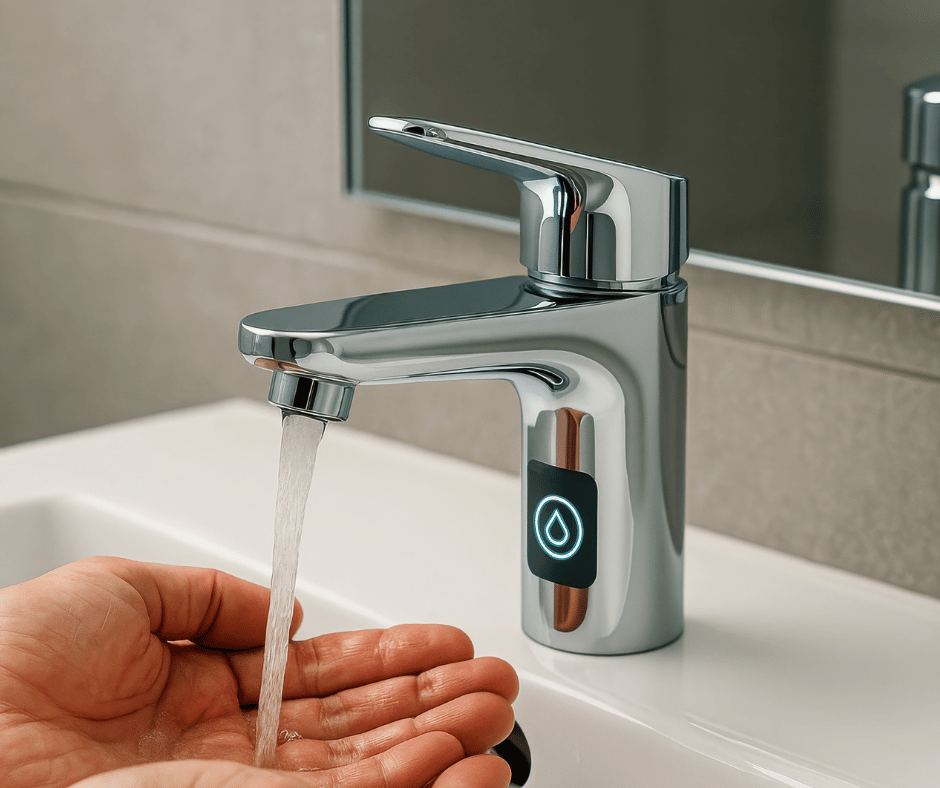
If you're searching "touchless faucet worth it Maple Grove" or "are motion sensor faucets reliable Minnesota," you're considering an upgrade that promises convenience but raises questions about reliability, cost, and long-term performance. Touchless faucets have evolved significantly since their commercial origins, but are they right for your Twin Cities home?
At First Class Plumbing, we install kitchen faucets including touchless models throughout Maple Grove, Plymouth, Minnetonka, and the Northwest Metro. Here's our honest assessment based on years of installations and service calls.
Touchless faucets use motion sensors—typically infrared or ultrasonic—to detect your hands approaching the spout. When the sensor detects motion within its range, it activates a solenoid valve that opens water flow. Move your hands away, and water shuts off automatically after a brief delay (usually 3-4 seconds).
Two power options for Maple Grove homes:
Battery-powered: Most residential touchless faucets use batteries (typically 4-6 AA batteries) to power the sensor and solenoid valve. Batteries last 1-2 years with typical household usage.
AC-powered: Some models hardwire to a 120V outlet under your sink. This eliminates battery replacement but requires electrical work and limits installation locations.
Manual override: Quality touchless faucets include manual handles or buttons for temperature adjustment and as backup if sensors malfunction or batteries die.
Sensor zones: Sensors detect motion in specific zones—typically 3-6 inches from the spout. Some models offer adjustable sensitivity to prevent false activations.
Hygiene and cleanliness: This is the primary benefit. When handling raw chicken in your Maple Grove kitchen, you can turn water on without touching the faucet with contaminated hands. Similarly, after mixing meatloaf or handling fish, touchless operation prevents spreading bacteria to your faucet handle.
For families with children, touchless faucets encourage handwashing without touching dirty handles.
Water conservation: Touchless faucets run only when hands are present. No accidentally leaving water running while you grab the soap or get distracted.
Studies show touchless faucets reduce water waste by 15-30% compared to manual faucets in typical households. For Maple Grove homeowners conscious of water usage, these savings add up over years.
Convenience with messy hands: Beyond raw meat, consider other situations:
Touchless activation is genuinely convenient when you can't touch the handle.
Reduced faucet wear: Without constant handle manipulation, mechanical components wear less. This potentially extends faucet lifespan.
Modern aesthetic: Touchless faucets signal updated kitchens. They're associated with contemporary design and smart home features.
False activations: Sensors sometimes trigger when you don't want water—reaching for a dish near the sink, wiping the counter nearby, or walking past the sensor zone. This wastes water and annoys users.
Better models offer adjustable sensitivity to minimize false triggers, but they never entirely eliminate this issue.
Failure to activate: Conversely, sensors sometimes don't detect hands when you want water—especially if your hands approach from outside the optimal detection zone or if something blocks the sensor.
You'll wave your hands around trying to activate the faucet, which is frustrating when you're in a hurry.
Battery replacement: AA batteries seem trivial until you're dealing with them. Remembering to keep spare batteries, noticing when power is low, and replacing batteries every 1-2 years adds maintenance that manual faucets don't require.
Sensor drift over time: Motion sensors can lose calibration over years, becoming overly sensitive or insufficiently responsive. Some models allow recalibration; others require professional service or replacement.
Temperature control limitations: With touchless activation, you set temperature at the handle and then use touchless operation. If you frequently want different temperatures (hot for dishes, warm for handwashing, cold for drinking), you're adjusting the handle constantly, negating some touchless convenience.
Installation complexity: Battery models are straightforward, but AC-powered versions require electrical outlets under sinks. Some Maple Grove homes don't have outlets in sink base cabinets, adding electrical work to installation costs.
Higher cost: Touchless faucets cost $200-$600, while quality manual faucets cost $150-$400. You're paying $100-$300 premium for the technology.
Repair costs: When sensors or solenoid valves fail, repair costs exceed manual faucet repairs. Sensor replacement costs $50-$150 for parts plus labor. Some proprietary electronics aren't easily repaired, requiring complete faucet replacement.
Based on our service calls in Maple Grove and surrounding communities:
Battery models are more reliable than AC models: Batteries eliminate electrical connection problems. The main failure points are dead batteries (not a real failure, just maintenance) and sensor degradation over time.
Brand matters significantly: Name-brand touchless faucets (Moen, Delta, Kohler) perform much better than cheap generic models. We've replaced numerous $150 no-name touchless faucets within 2-3 years, while Moen and Delta touchless faucets typically last 8-12 years.
Solenoid valve failures: The electrically-activated valve that controls water flow occasionally fails, requiring replacement. This happens more frequently with heavily chlorinated city water (though Maple Grove water isn't excessively chlorinated).
Sensor lifespan: Quality sensors last 10+ years. Cheap sensors fail within 3-5 years—sometimes suddenly, sometimes gradually losing sensitivity.
Overall reliability assessment: Quality touchless faucets from reputable brands are reasonably reliable. They fail more often than manual faucets, but failure rates aren't dramatic—maybe 15-20% over 10 years vs. 5-10% for quality manual faucets.
The convenience trade-off is worth it for some homeowners, not for others.
Moen (Top Recommendation)
Moen's MotionSense technology is mature and reliable. Their touchless faucets offer:
Popular Moen touchless models:
Moen offers both touchless and "touch-on" (tap anywhere on spout to activate) models. We see fewer service issues with Moen than other brands.
Delta
Delta's Touch2O and Touch2O with TempSense technologies work well:
Popular Delta touchless models:
Delta faucets sometimes require sensitivity adjustment during installation for optimal performance in specific sink configurations.
Kohler
Kohler's touchless faucets are well-designed but generally more expensive:
Kohler Response technology works reliably but costs $450-$700 for most models.
Brands to avoid:
Generic Amazon/home improvement store house brands under $200 rarely last. The sensors fail quickly, batteries drain fast, and build quality is poor.
If touchless appeals to you, invest in quality brands. The $150 you save on a cheap model becomes a waste when you replace it within three years.
Battery-powered advantages:
Battery-powered disadvantages:
AC-powered advantages:
AC-powered disadvantages:
Our recommendation for Maple Grove homes: Choose battery-powered unless you specifically object to battery replacement. They're more reliable, simpler to install, and battery changes are minor inconveniences compared to potential electrical problems.
Touchless isn't your only option for convenient kitchen faucets:
Touchless (motion sensor): No contact needed, hands free operation.
Touch-activated (tap-on faucets): Tap anywhere on spout or handle to turn water on/off. Uses similar electronics but requires physical contact (easier to control than pure touchless).
Moen and Delta offer touch-activated models that many homeowners prefer over pure touchless. You get convenience without false activation problems.
Pull-down manual with integrated spray: Traditional manual operation with modern convenience of pull-down spray heads. Simple, reliable, no batteries or sensors.
For many Twin Cities families, a quality pull-down manual faucet provides 90% of the convenience of touchless at lower cost and higher reliability.
Touchless faucets require minimum water pressure to function properly. Most manufacturers specify 20-30 PSI minimum.
Maple Grove city water typically provides 55-70 PSI, so pressure isn't usually an issue. However, if your home has low water pressure problems or you're combining touchless faucets with water treatment systems, verify your pressure meets requirements.
The solenoid valve in touchless faucets creates slight flow restriction compared to fully manual faucets. You typically don't notice this, but if you're sensitive to maximum flow, manual faucets deliver slightly better performance.
Touchless faucet installation:
Manual faucet installation for comparison:
The touchless premium is $100-$400 depending on models compared. For some households, this investment delivers daily convenience worth the cost. For others, it's unnecessary expense.
Households that benefit most:
Families with young children: Touchless encourages handwashing and reduces germy handle touching.
Avid cooks who frequently handle raw meat: The hygiene benefit is real and significant for people who cook from scratch regularly.
Accessibility needs: For people with arthritis, limited grip strength, or other mobility issues, touchless operation is genuinely helpful.
Environmentally conscious households: The water savings from automatic shutoff aligns with conservation values.
Modern/smart home enthusiasts: If you enjoy technology and appreciate connected/automated features, touchless faucets fit that lifestyle.
Germaphobes: If you're highly concerned about bacteria and cross-contamination, touchless operation provides peace of mind.
Households that don't need touchless:
Infrequent cooks: If you rarely prepare meals from scratch, the hygiene benefit is minimal.
Single-person households: Fewer people means less water waste in the first place.
Budget-conscious homeowners: The $200-$300 saved on a quality manual faucet could fund other kitchen improvements.
Traditional aesthetic preferences: Touchless faucets look contemporary. If you're creating a traditional or farmhouse kitchen, manual faucets might fit better aesthetically.
People who want maximum simplicity: Fewer electronics means fewer things to maintain or replace.
Renters or short-term homeowners: If you're not staying long-term, the convenience doesn't justify the investment.
After installing and servicing both types throughout the Northwest Metro:
Touchless faucets are worth it if:
Skip touchless and choose quality manual if:
There's no universal right answer. Touchless technology has matured and performs reasonably well, but it's not transformative for most households. It's a "nice to have" rather than a "must have."
Whether you choose touchless, touch-activated, or traditional manual faucets, professional installation ensures optimal performance. At First Class Plumbing, we install kitchen faucets throughout Maple Grove, Plymouth, Minnetonka, Brooklyn Park, and the entire Northwest Metro.
We'll help you evaluate whether touchless makes sense for your household, recommend specific models based on your needs and budget, and complete installation with proper sensor adjustment and testing.
Call 763-220-3765 today for kitchen faucet installation in the Twin Cities. We'll ensure your new faucet—whatever style you choose—performs reliably for years.
Contact First Class Plumbing for faucet installation backed by expertise. From basic manual faucets to advanced touchless models, we install them all with the attention to detail that prevents future problems.
Learn why you should call our experts at First Class Plumbing when you need urgent plumbing services.
Use these tips when installing a new faucet or sink in Plymouth.
.png)
Make sure your shower and tub are installed correctly with these tips.
Have aging pipes? Consider these options for pipe repairs and replacements.
Learn how our experts can help with your boiler repairs and replacements.
Learn about the common types of piping used in Plymouth, MN, homes.