
Give us a call: 763-220-3765

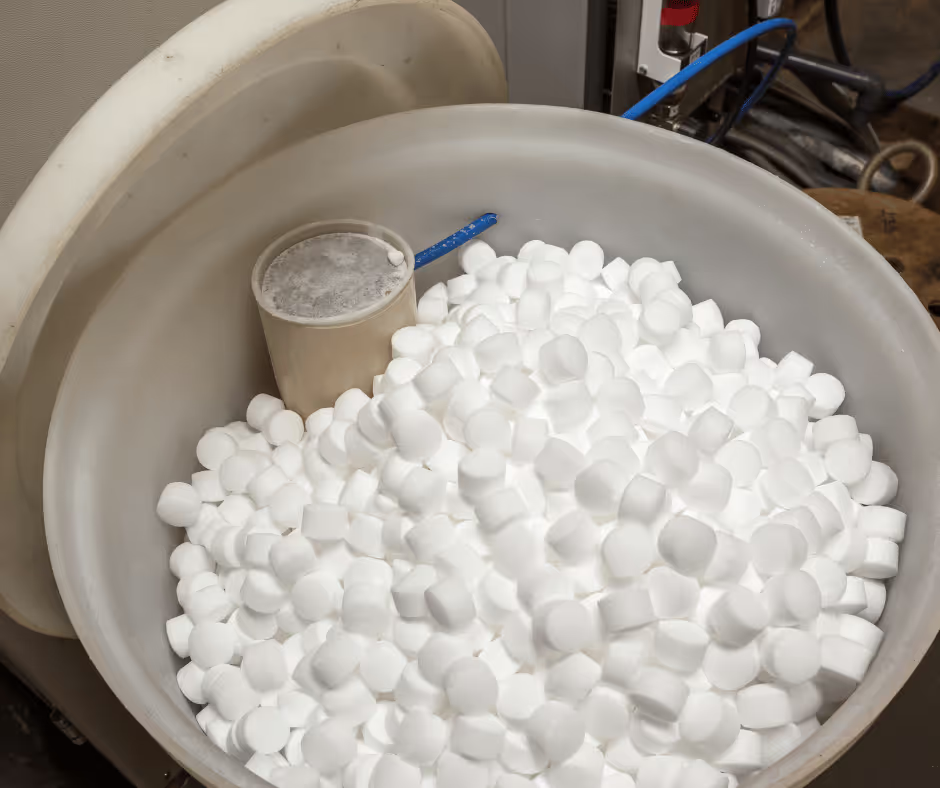
If you're searching "water softener using too much salt Maple Grove" or "why does my water softener need salt so often," you're noticing a problem that indicates your system isn't operating efficiently. Water softeners in Twin Cities homes should use salt at a predictable rate. When salt consumption increases dramatically, something's wrong.
At First Class Plumbing, we service and repair water softeners throughout Maple Grove, Plymouth, Minnetonka, and the Northwest Metro. Here's what causes excessive salt usage and how to fix it.
Before we discuss excessive salt usage, let's establish what's normal for Twin Cities homes.
A properly functioning water softener in Maple Grove typically uses 6-10 pounds of salt per regeneration cycle. How often regeneration occurs depends on:
For an average family of four in Maple Grove with a properly sized water softener, expect to add one 40-pound bag of salt every 4-6 weeks. That's roughly 8-12 bags per year.
If you're adding salt weekly or going through 20+ bags per year, your system is using excessive salt. Something needs adjustment or repair.
The most common cause of excessive salt use: your water softener is regenerating more often than necessary.
Water softeners regenerate on either a timer-based or demand-based schedule. Timer-based systems regenerate every few days regardless of actual water usage. Demand-based (metered) systems regenerate based on gallons of water used.
Timer set incorrectly: If your timer-based system regenerates every 2 days but your household only needs regeneration every 5 days based on actual water usage, you're wasting salt on unnecessary regenerations.
Meter reading incorrectly: Demand-based systems use a meter to track water volume. If the meter malfunctions or is calibrated incorrectly, the system thinks you're using more water than you actually are—triggering excessive regenerations.
Hardness setting too high: Water softeners need to know your water hardness for proper programming. If your system is set for 20 GPG hardness but your Maple Grove water is actually 15 GPG, the system will regenerate too frequently.
The solution: reprogram your water softener with correct settings for your actual water hardness and household usage. We can test your water, assess your household's actual consumption patterns, and optimize regeneration scheduling to reduce salt waste.
A salt bridge is a hard crust of salt that forms in your brine tank, creating a hollow space between the salt and the water below. When this happens, your water softener thinks it has plenty of salt (the tank looks full), but salt isn't actually dissolving into the water.
Without salt dissolving properly, regeneration can't occur effectively. The system tries to regenerate repeatedly without success, and you add more salt on top of the bridge—making the problem worse.
Salt bridges form when:
You can detect salt bridges by pushing a broom handle down through the salt in your brine tank. If you hit resistance before reaching the bottom, you've found a salt bridge.
Breaking up the bridge: Carefully break through the crusty layer with a broom handle, then remove the broken chunks. Let the remaining salt dissolve naturally rather than refilling immediately. This allows the system to operate properly again.
Prevention: Don't fill the salt tank more than 2/3 full. Use high-quality solar salt or pellet salt recommended for your system. Ensure adequate ventilation in your utility room to control humidity.
The venturi valve creates suction that pulls brine from the salt tank into the resin tank during regeneration. This small component is critical for proper operation.
When the venturi valve clogs with sediment, mineral deposits, or iron buildup, it can't create proper suction. The system may use more salt trying to compensate, or regeneration may not occur properly—meaning the system tries more frequently.
Symptoms of venturi valve problems:
Fixing this requires disassembling the control valve, cleaning the venturi valve thoroughly, and reassembling. This is delicate work best left to professionals. The venturi components are small and easily damaged.
For Maple Grove homeowners with iron in their well water, venturi valve clogging happens more frequently. Annual professional service prevents these buildups before they cause excessive salt consumption.
If your water softener was undersized when installed, it struggles to keep up with your household's water demand. An undersized system regenerates much more frequently than a properly sized one, burning through salt.
This often happens when:
A 32,000-grain water softener might be adequate for two people in a home with 12 GPG water. Add two more family members or increase hardness to 16 GPG (typical for many Northwest Metro areas), and that same softener regenerates twice as often.
If your water softener is undersized, your options are:
We can calculate whether your system is properly sized for your household during a service call. If undersizing is causing excessive salt usage and frequent regeneration, replacement with an appropriately sized system solves the problem permanently.
The resin beads inside your water softener tank do the actual work of removing hardness. Over time, resin can degrade or become fouled, reducing softening capacity.
Iron fouling: Minnesota well water often contains iron. Iron coats resin beads, preventing them from exchanging ions properly. The system uses more salt during regeneration trying to clean fouled resin, and regenerates more frequently because capacity is reduced.
Resin degradation: Resin beads have a lifespan of 10-20 years depending on water quality and usage. As resin degrades, capacity decreases. Your system compensates by regenerating more frequently, using more salt.
Channeling: Water should flow evenly through the resin tank. Sometimes preferential flow paths ("channels") develop, meaning water bypasses most of the resin. The system loses capacity and regenerates excessively.
Solutions for resin problems:
We diagnose resin problems during service calls by testing your water hardness after softening. If softened water shows remaining hardness, resin issues are likely.
Every water softener has a bypass valve that lets you send water around the softener for service or emergencies. If this valve is partially open (even slightly), unsoftened water mixes with softened water.
Your household gets a mixture of hard and soft water. You notice some hard water effects (maybe not as bad as before softening, but still present). Meanwhile, only part of your water flows through the softener, so salt usage seems excessive relative to the results you're seeing.
Check your bypass valve position. It should be fully closed during normal operation, directing all water through the softener. Some bypass valves have handles that show valve position; others require careful inspection.
This is an easy fix: close the bypass valve fully. If the valve is stuck or broken, replacement is straightforward and inexpensive.
Not all salt is created equal for water softeners. Using the wrong type can increase salt consumption or cause operational problems.
Rock salt: This is the cheapest option but contains more impurities. These impurities don't dissolve, building up in your brine tank and potentially causing salt bridges. Rock salt may seem economical, but it creates maintenance problems.
Solar salt pellets: These are our recommended option for most Maple Grove water softeners. Solar salt is relatively pure, dissolves well, and causes few problems. It costs more than rock salt but performs better.
Potassium chloride: Some homeowners use potassium chloride instead of sodium chloride for health reasons. Potassium chloride requires more product per regeneration and costs significantly more. If you're using potassium chloride, higher salt (technically potassium) consumption is normal.
Evaporated salt pellets: The most pure option, these dissolve quickly and leave almost no residue. They cost the most but create the fewest problems.
Stick with solar salt pellets for best results in Twin Cities water softeners. The modest additional cost compared to rock salt is worth it for trouble-free operation.
If your brine tank has a slow leak, salt water drips into the drain continuously rather than only during regeneration. This wastes salt without providing any softening benefit.
Check around your brine tank for:
Brine tank leaks can occur at:
Most brine tank leaks require professional repair. Tank cracks may mean tank replacement. Connection leaks need proper sealing or fitting replacement.
The electronic control valve manages your water softener's operation—deciding when to regenerate, controlling water flow, and managing the regeneration process. When control valves malfunction, regeneration patterns become erratic.
Common control valve problems:
Symptoms include:
Control valve problems require professional diagnosis with specialized tools. Sometimes cleaning or adjusting solves the issue. Other times, electronic components need replacement.
For older water softeners (15+ years) with control valve problems, replacing the entire system often makes more sense than expensive control valve repairs on aging equipment.
Have your system professionally evaluated: We'll test your water hardness, assess your household's actual water usage, and optimize regeneration programming. This often reduces salt consumption by 30-50% without any parts replacement.
Use high-efficiency regeneration: Modern water softeners use "demand-initiated" regeneration based on actual water usage rather than timers. If you have an older timer-based system, upgrading to demand-initiated can cut salt usage significantly.
Adjust hardness setting accurately: Many systems are programmed for higher hardness than actually exists. We test your Maple Grove water and program the exact hardness level, preventing over-regeneration.
Break up salt bridges promptly: Check your brine tank monthly. If you see salt bridges forming, break them up before they cause operational problems.
Install an iron filter if needed: For homes with well water containing iron, an iron filter before the softener prevents resin fouling and reduces salt consumption.
Schedule annual maintenance: Professional service catches small problems before they cause excessive salt usage. Cleaning the venturi valve, checking regeneration programming, and testing water quality ensures efficient operation.
Don't overfill the salt tank: Keep salt level below 2/3 full. Overfilling contributes to salt bridge formation and creates humidity problems in the tank.
Sometimes excessive salt consumption signals that your water softener is nearing end-of-life:
Age over 15 years with multiple problems: If your 18-year-old softener needs resin replacement, control valve repair, and has chronic salt bridges, replacement is more cost-effective than repairs.
Severe undersizing: If your system is dramatically undersized for your household and you're burning through salt trying to keep up, invest in properly sized equipment.
Unrepairable control valve on older systems: Control valve replacement on old softeners can cost $400-$600. For that money, you're partway to a new system with modern efficiency.
Resin replacement cost approaching new system cost: Resin replacement runs $300-$500. If your system also needs other repairs, new equipment makes more financial sense.
Modern water softeners are significantly more efficient than models from the 1990s or early 2000s. Salt-efficient designs, demand-initiated regeneration, and better control systems mean new softeners use less salt while producing better water quality.
Excessive salt usage isn't just expensive—it signals efficiency problems that affect your water softener's performance. Your household might be getting partially softened water while wasting money on salt.
At First Class Plumbing, we diagnose and repair water softener problems throughout Maple Grove, Plymouth, Minnetonka, Brooklyn Park, and the entire Northwest Metro. We'll identify why your system is using excessive salt and recommend the most cost-effective solution.
Call 763-220-3765 today to schedule water softener service in the Twin Cities. We provide honest assessments, transparent pricing, and repairs backed by our workmanship warranty.
Contact First Class Plumbing for water softener service you can trust. Whether your system needs adjustment, repair, or replacement, we'll help you get efficient operation and properly softened water throughout your home.
Learn why it's essential to call trusted pros for toilet installations and repairs.

Shower valve dripping? It can be due to these common problems.
Experiencing frequent toilet clogs? Consider replacing it with these brands.
Should you install a water softener or a water filtration system? Consider these factors.
Worried your water softener is using too much salt? Get tips on common problems.
Attempting your own plumbing repairs can cause more damage to your system. Learn why you need a plumber.